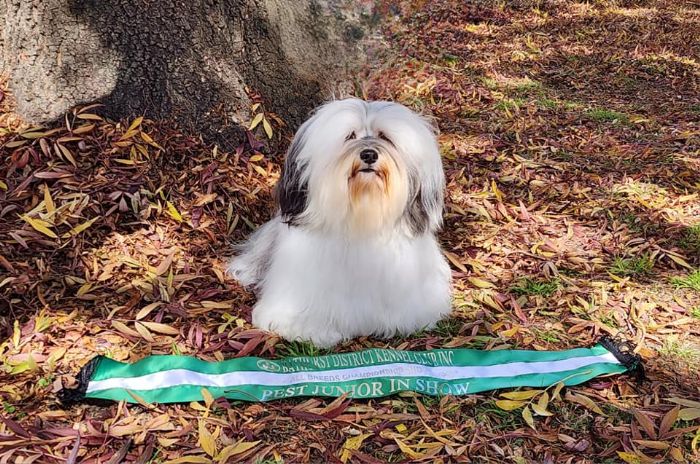
The Havanese Breed

The Havanese is the national dog of Cuba. It was developed from the now extinct Blanquito de la Habana ("little white dog of Havana"). The Blanquito descended from the also now-extinct Bichón Tenerife. It is believed that the Blanquito was eventually cross-bred with other bichon types, including the poodle, to create what is now known as the Havanese. Sometimes referred to as "Havana Silk Dogs", this was originally another name for the Blanquito Whatever the actual origins of bichon dogs, these little dogs soon became devoted companions to the Spanish colonists in Cuba and were highly admired by the nobility.
The Havanese is small in size and sturdy in structure with a tail carried over its back and ears that drop. The coat is abundant, long, and silky, and comes in a huge variety of colours. The Havanese has a spirited personality and a curious disposition, and is notable for its springy gait, a characteristic that distinguishes the breed from all others. The Havanese is considered an ideal family pet and a true companion dog, they have a natural affinity with children and will play endlessly with them. They are highly adaptable to almost any environment. Because of their strong social needs, Havanese will not thrive in an environment where they are isolated from their family.
Havanese are non-shedding and hypo-allergenic.
They need daily brushing, if they aren't regularly clipped, to remove dead hair and tangles.
The Havanese has moderate exercise needs. They will benefit from a brisk daily walk or a fun playtime with their owner. Romping inside the home can also provide enough activity. Never over-exercise a Havanese of any age. If they are panting and struggling to keep up, it is time to go home.
They are highly adaptable to almost any environment. Because of their strong social needs, Havanese will not thrive in an environment where they are isolated for several hours each day. Havanese do well in both houses and apartments.
A word of warning.......you really can't stop at one!!!!
Understanding Correct Havanese Type – What the FCI Standard Really Says
The Havanese is often described as a “small, sturdy dog, slightly longer than tall” — but correct type is defined by very specific proportions, particularly in the body and the head.
🔹 Height to Length Ratio – 4 : 3
A correct Havanese is clearly longer than tall.
Measured from the point of shoulder to the point of buttock compared to height at the withers, the ratio should be 4:3
This gives the breed its characteristic outline — balanced, rectangular, sturdy, and never square or cobby.
🔹 Head Proportions – A Hallmark of True Type
This is where true Havanese type is so often misunderstood.
The FCI standard specifies that:
👉 The length from the nose to the stop is EQUAL to the length from the stop to the occiput.
This creates a balanced head, not a short muzzle.
The standard also calls for:
A broad, slightly rounded skull
A well-defined stop
Large, dark, almond-shaped eyes with a soft, intelligent expression
Ears set relatively high, carried forward when alert
The expression should be sweet, lively, and gentle — never snipey, coarse, or exaggerated.
🔹 Substance Without Coarseness
Havanese should be well boned and sturdy for their size, but never heavy, clumsy, or fine and leggy.
🔹 Movement Reflects Structure
Correct proportions allow for light, elastic, effortless movement with reach and drive — never restricted or mincing.
When head balance and body proportions are correct, you don’t just see a coated toy dog — you see unmistakable Havanese type as described by the FCI.
Preserving these hallmarks is essential to protecting the integrity of our beautiful breed.